
The 22nd Sunday After Pentecost
Sunday, November 9, 2025
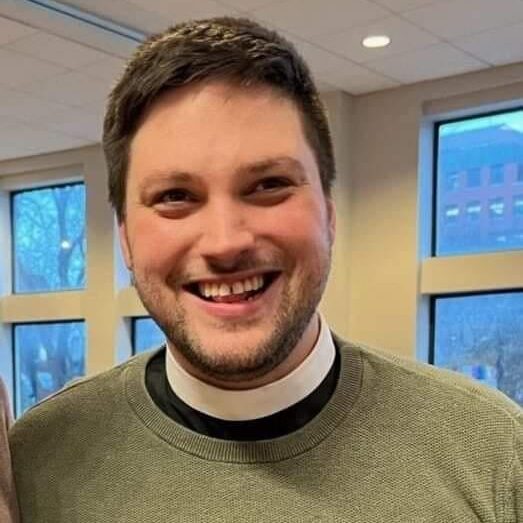
The Very Rev. David Wilcox
It’s not hard these days to feel like the world is teetering. The ground beneath us seems to shift every week. The news cycle spins with conflict, division, and uncertainty. We worry about our communities, our children, our future. And sometimes it’s not just the world out there — sometimes it’s our own lives that shake. A loss we didn’t expect, a prayer that feels unanswered. We know what it is to sit, as Job did, in the ashes, wondering where God is in the midst of it all.
The people St. Paul wrote to in Thessalonica knew what that felt like. They were frightened, confused, and weary of waiting. Rumors had begun to spread that the end had already come, that they had somehow missed out on God’s promises. In the midst of that fear, Paul’s words are gentle but firm: “Do not be quickly shaken in mind or alarmed… stand firm and hold fast.”
Stand firm. That’s not easy to do when everything is moving around you. But Paul isn’t talking about blind stubbornness or denial. He’s talking about the kind of steady, rooted hope that comes from knowing whose we are. He reminds the church that they are chosen and loved by God, called through the gospel to share in the glory of Christ — that they are children of God and heirs of eternal life. And that truth, Paul says, is what keeps us steady when the world feels unsteady.
Job understood that kind of hope long before Paul ever wrote to Thessalonica. Job’s life had fallen apart — family, health, security, all gone. He sits in the ashes surrounded by voices that tell him to give up, to curse God and die. But out of that darkness comes one of the most luminous declarations of faith in all of Scripture: “I know that my Redeemer lives, and that at the last he will stand upon the earth.”
Job doesn’t see how it will happen. He has no guarantee that things will get better. But still, he trusts that God is not finished — that there is a Redeemer who will stand at the last, who will vindicate him, who will bring life out of death. That is the hope that anchors Job’s soul, and it’s the same hope that anchors ours.
This is not a naïve hope. It’s not wishful thinking or spiritual escapism. It’s the kind of hope that looks honestly at the brokenness of the world and still says, “Christ has come to destroy the works of the devil.” It’s the kind of hope that faces the reality of death and declares, “Death will not have the final word.” It’s the kind of hope that holds fast to the promise that we are destined not for despair, but for glory — that we are being made like Jesus, transformed by his grace until the day he comes again in power and great glory.
That’s why Paul says we can stand firm, not because life is easy, but because the love that holds us is stronger than anything that threatens us. God has already begun the work of redemption in us, and that work will not fail. Through Christ, we are made new , purified, refined, restored, so that our lives may reflect the holiness and beauty of the One who calls us his own.
And this work of God in us isn’t something abstract or distant , it’s happening here and now, in the ordinary fabric of our lives. Every time we choose mercy over bitterness, every time we forgive someone who has hurt us, every time we keep faith when faith feels hard, the Redeemer is at work. He is shaping our hearts, steadying our steps, teaching us to trust in things unseen. Standing firm in hope isn’t about gritting our teeth and holding on; it’s about opening our hearts to the grace that holds us. It’s about living each day with quiet courage, knowing that even when we falter, the hand of Christ is already reaching toward us to steady us, and lift us up.
When Jesus meets the Sadducees in today’s Gospel, they try to trap him with a riddle about marriage and resurrection. They don’t believe in life after death, so they come to test him. But Jesus doesn’t get lost in their argument. Instead, he lifts their vision higher. He tells them that the life of the resurrection is not just a continuation of this life, it’s something altogether new. “Those who are considered worthy of a place in that age,” he says, “are children of God, being children of the resurrection.”
In the resurrection, we are not bound by the fears and divisions of this world. We are not trapped in the cycles of decay and loss. We belong to the God of life, and as Jesus says, “He is not the God of the dead, but of the living; for to him all are alive.”
That’s the promise that steadies us. To God, Abraham and Sarah are alive. Job is alive. The saints who have gone before us are alive. Our loved ones who rest in Christ are alive. And because our Redeemer lives, we too will live. That’s not a metaphor, it’s the deepest truth of our faith. Death has been defeated. The works of evil are being undone. The life that is in Christ has already begun to flow through us.
And if we truly believe that, if we truly believe that death has been swallowed up in victory, then we begin to live differently. We begin to love with greater tenderness, to forgive with greater generosity, to give ourselves away without fear of losing. Hope in the resurrection doesn’t pull us out of this world; it sends us more deeply into it. It gives us eyes to see that even now, God’s kingdom is breaking through: in acts of compassion, in reconciled relationships, in moments of unexpected joy. Each of those is a small glimpse of the day when Christ will stand upon the earth and make all things new.
So we stand firm. We stand firm not because we are strong, but because the One who holds us is. We stand firm not because the world is calm, but because our hope reaches beyond this world. We stand firm because we are children of God, heirs of eternal life, and participants in the victory of Christ.
And while we wait for that day when he comes again with power and great glory, we live as people who already belong to that kingdom. We love in the face of hatred. We forgive when it makes no sense to forgive. We serve when it would be easier to turn inward and ignore the need. We purify our hearts, not out of fear, but out of longing… longing to reflect the light of the One whose image we bear.
That’s what Christian hope looks like: not an escape from the world’s pain, but courage within it; not indifference to suffering, but compassion that runs deep. Hope is what gives us the strength to keep believing that even when everything else falls apart, God’s promises will not. Hope is what allows us to look at the cross and see resurrection on the horizon.
And sometimes that hope is carried for us by others, by the Church, by the communion of saints, by those who pray when we cannot pray. When our own faith falters, the faith of others holds us up. That’s part of the gift of belonging to Christ’s body. Together, we remind one another that the story isn’t over, that our Redeemer lives, that life will have the last word. Hope is not a solitary act; it is the shared song of a people who trust that love is stronger than death.
When we live with that kind of hope, we become signs of the kingdom ourselves. We become small reflections of the glory that is coming — living reminders that our Redeemer lives, and that one day, all things will be made new.
So when the world trembles, remember this: the God who created you has claimed you. The Christ who died for you has risen and reigns. The Spirit who sanctifies you even now is shaping you to be like him. And when he comes again in power and glory, you will stand before him not as a stranger, but as a beloved child, radiant with the light of his life.
Until that day, stand firm. Stand firm in faith. Stand firm in hope. Stand firm in love. For our Redeemer lives and because he lives, we will live also. Amen.