
Christmas Eve 2025
Wednesday, December 24, 2025
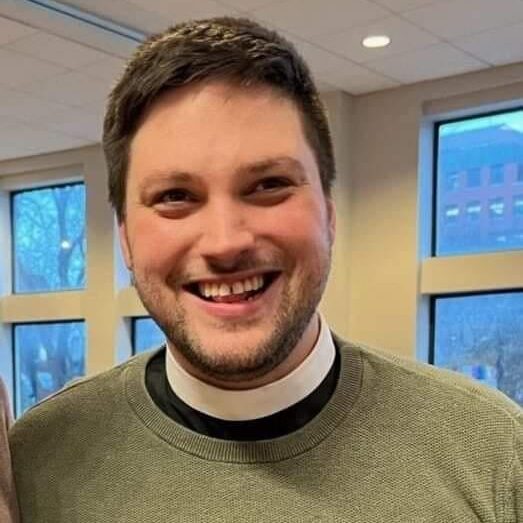
The Very Rev. David Wilcox
Tonight we hear again a story we know by heart. Familiar words. Familiar scenes. Angels. Shepherds. A child laid in a manger. And still, if we are really paying attention, this story we tell year after year ought to stop us in our tracks.
Because what we are celebrating tonight is not simply the birth of a child long ago. We are celebrating the mystery at the very heart of our faith: that for us and for our salvation, God took on human flesh and came to dwell among us.
Tonight’s readings draw us into one unfolding story. God’s promise fulfilled. God’s presence made real. God’s grace made known among us.
Isaiah speaks to a people who know darkness well. Not poetic or abstract darkness, but real darkness. Fear. Violence. Uncertainty. A sense that the world is heavy and that tomorrow may not be better than today. And into that reality, Isaiah dares to proclaim hope. The people who walked in darkness have seen a great light. Not will see. Have seen. God is already at work, already moving toward God’s people.
And how does that light come? Not as an idea. Not as a set of principles. Not as a distant intervention from heaven. The light comes as a child. A child born into vulnerability. A child who will carry names far greater than anyone could imagine. Wonderful Counselor. Mighty God. Everlasting Father. Prince of Peace.
Luke then takes that ancient promise and plants it firmly in history. He gives us names and places. A census. An emperor. A governor. A small town. A long journey. Luke wants us to know that this story doesn’t happen in a mythic nowhere. It happens in the real world. A world shaped by power and politics and anxiety. A world not so different from our own.
And in the middle of all that, God comes quietly.
No palace. No throne. No royal procession. God comes into the world almost unnoticed. Born to a couple far from home. Laid in a feeding trough because there was no room anywhere else. The Word through whom all things were made enters his own creation not with force, but with humility.
This is the great mystery, and the great gift, of the incarnation. God does not save us from a distance. God does not shout instructions from heaven. God comes close. So close that he takes on our flesh. So close that he breathes our air, walks our roads, knows hunger and fatigue, joy and grief.
For us and for our salvation.
God does not become human as a divine experiment. God does not put on humanity like a costume. God becomes truly human because our humanity needs healing from the inside. God enters the fullness of our condition so that nothing about our lives is beyond redemption.
That means Jesus knows the full weight of human life. Birth and growth. Work and rest. Friendship and betrayal. Suffering and death.
And that is good news. Good news for anyone who has ever wondered whether God really understands. Good news for anyone who has prayed and felt alone. Good news for anyone who carries grief, exhaustion, regret, or fear into this holy night.
The shepherds help us see this clearly. They are not powerful. They are not polished. They are not prepared. They are simply doing their jobs, minding their flocks, when heaven suddenly breaks open around them. And the angel’s first words are not instruction or judgment, but reassurance: “Do not be afraid.”
Fear is so often our default posture. Fear that we are not enough. Fear that the world is too broken to be healed. Fear that God might be disappointed in us. But the good news of Christmas is that God comes not to increase our fear, but to drive it away. God comes not to condemn the world, but to save it.
Paul puts it simply. The grace of God has appeared, bringing salvation to all. Grace is not an abstraction. Grace has taken on a face. Grace has been born into the world.
And that grace does something. It does not leave us unchanged. It teaches us how to live. Not by fear, but by freedom. Not by grasping, but by hope. Not by violence, but by love. The child in the manger grows into the man who gives himself for us, who lays down his life to redeem and restore.
Christmas cannot be separated from Good Friday or Easter. The wood of the manger already points us toward the wood of the cross. The child wrapped in bands of cloth will one day be wrapped again and laid in a tomb. And that is precisely why this night matters. God does not turn away from suffering. God enters it. God transforms it.
So what does this mean for us, here and now?
It means you do not have to have everything figured out tonight. The shepherds didn’t. It means you do not have to be fearless or strong or perfectly faithful. You simply have to show up. God meets us as we are.
It means no part of your life is too ordinary for God’s presence. If God can be found in a stable, God can be found in your kitchen, your workplace, your hospital room, your grief, and your joy.
And it means God is not finished with this world. The light that shines in the darkness has not gone out. It still shines. Sometimes softly. Sometimes quietly. But always faithfully.
In a few moments, we will come to the altar. We will receive bread and wine. And we will dare to believe that God meets us there. The same God who took flesh in Mary’s womb gives himself to us again. He comes to be born in us.
And this is the good news of Christmas. God has not stayed distant. God has not abandoned this world to its darkness. God has come near, and God is still coming near. In Jesus Christ, God has entered our life, our suffering, our joy, and even our death, and nothing is ever the same again.
Because God has taken our flesh, our lives matter. Because God has shared our humanity, our pain is not ignored. Because God has given himself for us, sin and death do not have the final word. Love does. Life does. God does.
So tonight, as we receive this holy gift, we are not only remembering something that happened long ago. We are being drawn once more into God’s saving life. The light shines in the darkness, and the darkness has not overcome it.
This is the mystery we celebrate tonight. This is the hope we carry into the world. For us and for our salvation, God has come, and God is with us still.
Glory to God in the highest. And on earth, peace.